Building a Habit App That Never Shames You
Most habit trackers are built on a lie: that the way to make you consistent is to punish you when you’re not. Break a streak and watch the number reset to zero. Miss a day and get a guilt-tinted notification. It works right up until the day you slip — and then the shame does the opposite of what you needed, and you delete the app.
I have ADHD. I’ve deleted a lot of those apps. So I built the one I actually wanted: CYBER//FIT — a cyberpunk self-improvement tracker with a single non-negotiable rule. It never shames you.
Forgiving by design
The whole product is organized around removing guilt as a mechanic:
- Skip is not fail. Missing a day doesn’t zero your progress.
- Streak shields auto-absorb misses, so a bad week doesn’t erase a good month.
- A reset is a “reboot,” never a “failure” — you come back to “Good to see you, choom. Ready for a new gig?”, not a pile of red X’s.
- It never shows you a count of missed days or notifications. That number helps no one. It’s not in the app.
Gamification is there — XP, levels, cosmetic cyberware unlocks — but it’s scaffolding, meant to get a habit started and then get out of the way as real progress data takes over. Crucially, every reward is cosmetic. Nothing useful is ever locked behind progress or payment.
Off-grid by design
I’m a privacy-first, local-first engineer, and the app reflects it:
- After first load it works 100% offline, forever — an installable PWA with a local database. There’s no account. There’s no server for your data to go to.
- No analytics, no telemetry, no cookies, no tracking. Backup is a local file you control.
- Notifications are strictly nice-to-have. If you opt in, the relay stores only an anonymous push token and the time slots you picked — it’s blind to your schedule and your completions by design.
It’s free forever, open source (MIT), and the whole thing runs on Cloudflare Workers for about the cost of a domain.
The AI sidecar: a coach you can text
The piece I’m most proud of as an engineer is private and personal: cyber-trainer, an SMS coach that runs on my own hardware.
I text it in plain English — “just finished the workout” — and it logs the right entry for me. The architecture is deliberately paranoid:
- A text hits a Twilio number, forwarded through a Cloudflare Tunnel (no inbound ports open anywhere).
- The request lands on a service running on my Jetson, co-located with a local Qwen3-8B model served by llama.cpp.
- The model’s only job is to turn one message into one strict JSON intent. It never touches storage and never touches the network.
- My own code owns every read and write to the encrypted data vault, then texts back a confirmation.
That separation — the LLM interprets, my code acts — is what lets a small local model run a real workflow safely. No cloud AI, no data leaving my house, the same local-first ethic as the app it feeds.
Why build it this way
Because the technology should serve the person, not the metrics dashboard. A habit app’s job is to make it a little easier to be who you’re trying to be — on your good days and the day after a bad one. Punishment-free isn’t a soft feature; for an ADHD brain it’s the difference between a tool you keep and one you delete.
If any of that resonates, try it — no signup, nothing to lose, and it’ll never make you feel bad for missing Tuesday.
Update — screenshots and a user guide
When I published this, the repo had no screenshots — a privacy-first app has a
bootstrapping problem: I wasn’t going to post my own vitals, and empty-state
screenshots sell nothing. The fix was to treat screenshots like a build
artifact. A seed script generates a fully fictional demo profile — three weeks
of habits, workouts, reading logs, even PHQ-9 results, all invented and
schema-checked against the real app — and a Playwright pipeline installs it
through the app’s own backup-import path, then walks every screen and captures
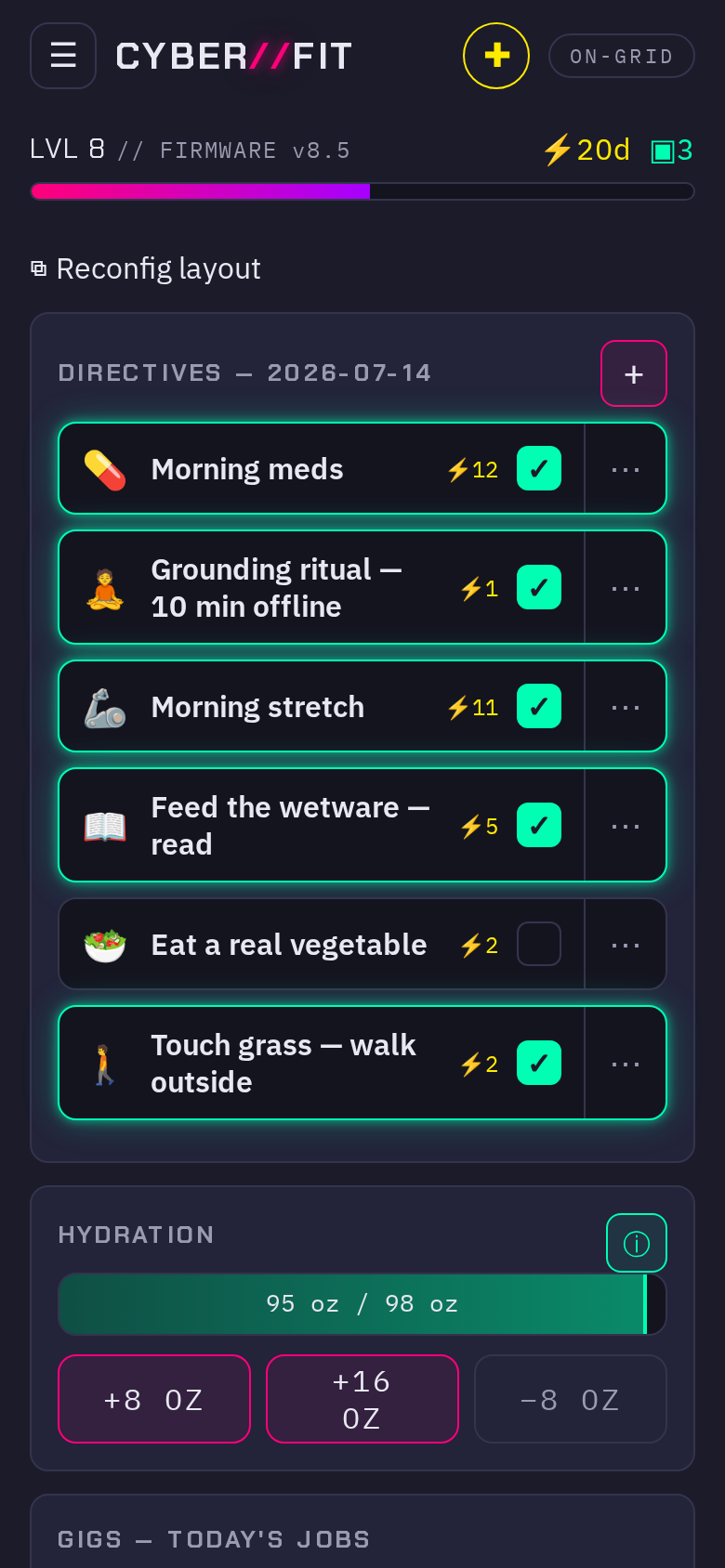
it. npm run shoot:demo, nine deterministic PNGs, no human data anywhere.
So here’s what the app actually looks like:
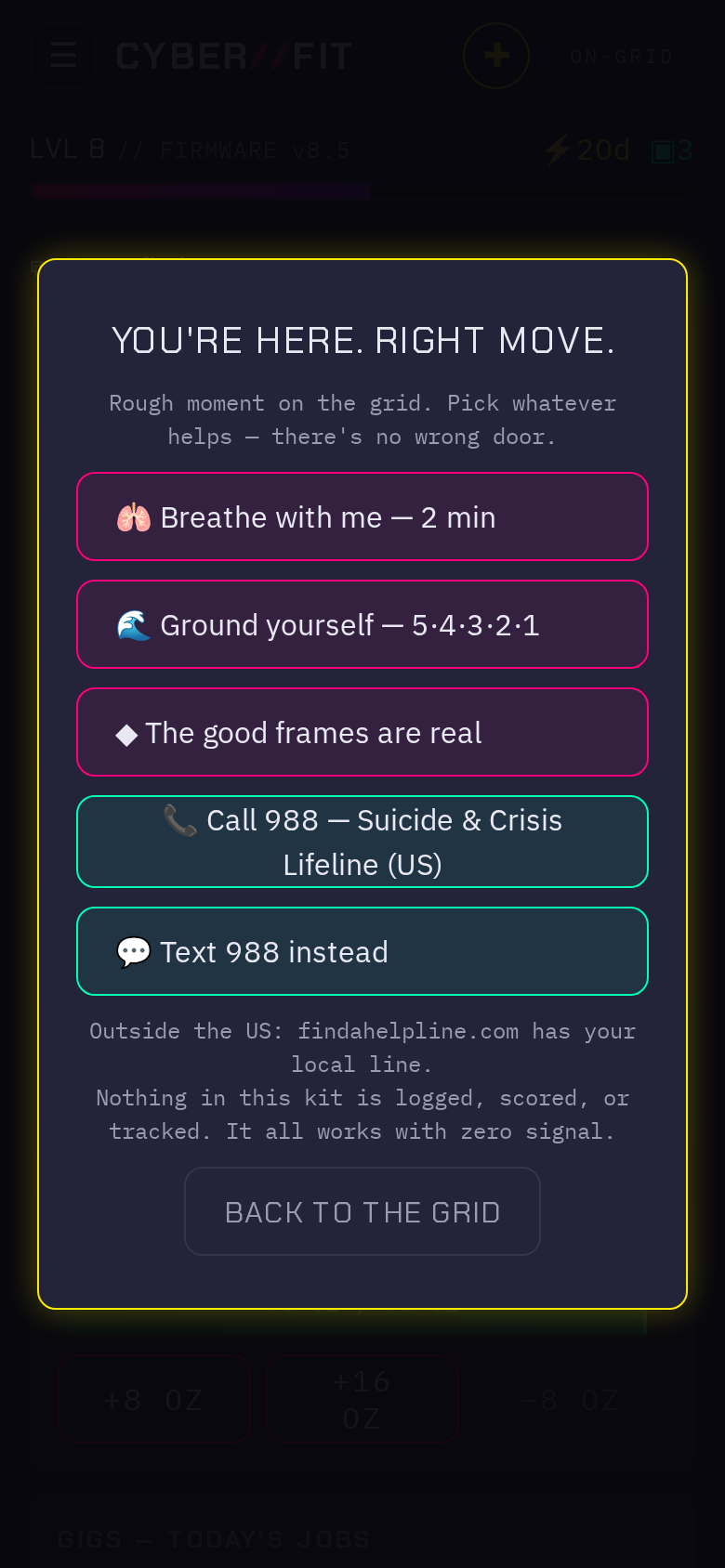
And the screen I most wanted people to see — the crash kit. One tap from anywhere: paced breathing, grounding, and call/text 988. Nothing in it is logged, scored, or tracked, and it works with zero signal:
The same pipeline now feeds a full user guide — every screen, documented with the same fictional profile. When the UI changes, I re-run one command and the docs stop lying.